 ultimate-guide
Buy Custom 3D Printed Parts Online: A Complete Guide
Last Updated: November 4, 2026
Quick Summary
To buy custom 3D printed parts online, upload your design file, review the quote, approve the order, and the part ships to you. Choosing the right printing technology and preparing a clean STL file before upload helps avoid delays and price changes.
- Upload a design file, review the quote, then approve the order before production begins.
- FDM suits functional prototypes, SLA suits fine detail and smooth surfaces, and SLS suits durable complex parts.
- Confirm the model is watertight and that units and scale match your intended final size.
- Keep wall thickness above the minimum for your chosen process to avoid breakage during cleanup.
- Treat the instant quote as an estimate, since file review can trigger repairs or a revised price.
Table of Contents
- How Online Custom 3D Printing Services Work
- Choosing a Printing Technology: FDM, SLA, SLS and Beyond
- Best Materials for Custom 3D Printing
- How to Prepare STL Files for 3D Printing
- File-Readiness and Design-for-Manufacturing Checklist
- What Drives the Cost of Custom 3D Printed Parts
- Custom 3D Printing Turnaround Time and Delivery Expectations
- Quality Assurance, Inspection and Part Accuracy
- Placing Your Custom Order With 3DPrintMagicStudio
- Frequently Asked Questions
How Online Custom 3D Printing Services Work
Buying custom 3D printed parts online is straightforward once you know the sequence: you upload a file, receive a quote, approve the order, and the part ships to your door. At 3DPrintMagicStudio, we accept custom requests for personalized items. The process is more forgiving than most people expect, but a few decisions made early save time and money later.
The typical workflow starts with a design file. Some services also accept a written description. Once a file is uploaded, you review the part details, confirm the order, and production begins. Pricing depends on quantity, dates, and delivery, so check our website or request a quote for current pricing.
A common mistake is assuming the quote is final before the file has been checked. Wall thickness, overhangs, and scale problems can all change the price or require a revision, so read any feedback before approving.
Choosing a Printing Technology: FDM, SLA, SLS and Beyond
No single printing technology wins every job. Fused deposition modeling (FDM), stereolithography (SLA), and selective laser sintering (SLS) each trade off surface finish, strength, cost, and lead time differently, so the right choice depends on what the part has to do.
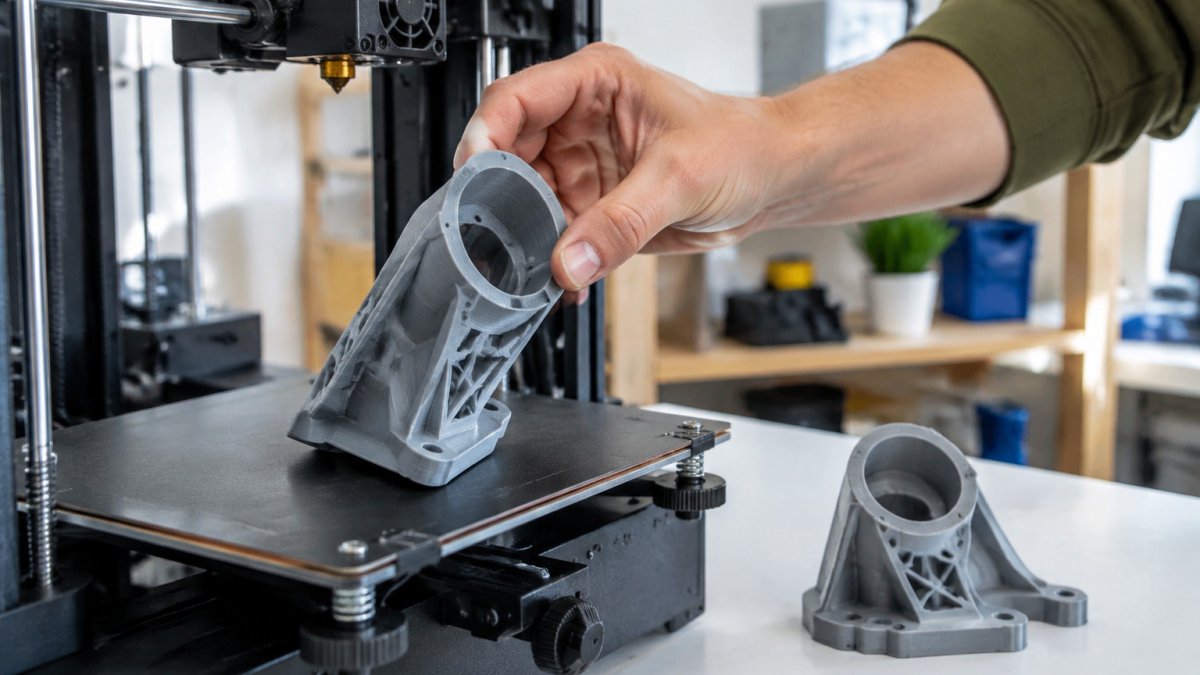
!Close-up of a freshly printed plastic part being lifted from a 3D printer build plate in a bright workshop, with a second finished part resting on a clean table
The three most common printing technologies differ in what they do best, so the right choice depends on the part's purpose.
| Technology | Best for | Key difference |
|---|---|---|
| Fused deposition modeling (FDM) | Functional prototypes and sturdy parts | Trades surface finish for strength and cost |
| Stereolithography (SLA) | Parts needing fine detail and smooth surfaces | Trades cost and strength for finish quality |
| Selective laser sintering (SLS) | Parts needing durability and complex geometry | Each technology weighs finish, strength, cost and lead time differently |
Best Materials for Custom 3D Printing
Material choice drives both performance and price. If the part will see heat, sunlight, or repeated stress outdoors, say so when you order, because material selection changes what is appropriate.
How to Prepare STL Files for 3D Printing
An STL file describes a part's surface as a mesh of triangles, and it is the most common format for online printing. Before uploading, confirm the model is watertight, meaning it has no holes or inverted faces that would confuse the slicer. Check the units and scale, since a part modeled in inches but exported as millimeters will arrive very differently from what you intended.
Keep wall thickness above the minimum for your chosen process, and avoid extremely thin features that will break during cleanup.
Watch out: a file that looks fine in your viewer can still contain non-manifold edges that cause a failed print, so run a mesh repair check before upload.
File-Readiness and Design-for-Manufacturing Checklist
Use this list before you upload:
- Model is watertight with no open edges or inverted normals
- Units and scale match the intended final size
- Wall thickness meets the minimum for the chosen process
- Overhangs are minimized or noted for support planning
- Mating parts have clearance, typically a few tenths of a millimeter
- Critical dimensions and tolerances are labeled in the notes
- Intended use, load, and environment are described in the order
What Drives the Cost of Custom 3D Printed Parts
Watch out: a quote that looks low can rise after file review if the model needs repair, reorientation, or added supports, so treat the instant number as an estimate until the file has been checked and confirm what triggers a re-quote.
Custom 3D Printing Turnaround Time and Delivery Expectations
For a gift with a fixed deadline, order early and build in buffer time for shipping.
Quality Assurance, Inspection and Part Accuracy
If a part arrives out of specification, ask before ordering how remakes, refunds, and returns are handled.
Placing Your Custom Order With 3DPrintMagicStudio
To order, upload your file or describe your design, then confirm the details with us. Describing your intended use helps when you request a custom piece.
3DPrintMagicStudio accepts custom requests for personalized items. For current pricing or to start a custom request, use the Contact option on our site and we will get back to you with a quote.
Frequently Asked Questions
Where can I find custom 3D printed parts online?
Custom 3D printed parts are available from online 3D printing services, including small makers who sell through marketplaces and studios that accept custom requests. When comparing options, look for clear descriptions of the materials and printing processes offered, a way to upload your own 3D file or describe your design, and a transparent quoting process. 3DPrintMagicStudio accepts custom requests for personalized items, so you can describe your idea and ask for a quote before committing to an order. Compare a few providers on these points rather than choosing by price alone.
How do I order custom 3D printed parts online?
Most online orders follow the same steps: submit a design or a detailed description, confirm the details, and wait for production and shipping. Start by gathering your dimensions, intended use, and any fit requirements, since these determine material and process choices. If you do not have a CAD file, describe what you want in as much detail as possible and ask whether the studio can model it. Confirm the final specifications in writing before you pay, so the part you receive matches what you approved.
How do I choose the right material for my custom 3D printed part?
The right material depends on how the part will be used. Decorative and display items can use standard plastics that prioritize appearance and detail. Functional parts such as brackets, clips, or gear-style components usually need tougher materials like nylon or PETG, which handle impact and repeated stress better. Parts exposed to heat, sunlight, or moisture, such as outdoor camping gear, need materials chosen for those conditions. Ask your provider which material suits your environment and how it performs under the stress your part will face.
What factors influence the cost of custom 3D printed parts?
Pricing depends on quantity, dates, and delivery, so the most reliable way to know your cost is to request a quote with your exact specifications. For current prices and a quote on your project, visit the 3DPrintMagicStudio website and submit your request.
How can I make sure my 3D model is ready for professional printing?
Check that the model is a closed, watertight mesh with no holes or inverted faces, and that its walls are thick enough to survive printing and handling. Confirm the overall dimensions are in the correct units, and make sure features such as threads, snap fits, or clearances are sized with the printing process in mind. Remove unnecessary internal geometry and export the file in a standard format such as STL or 3MF. Running your model through a mesh-repair check before uploading can catch most common problems.
What are the differences between FDM, SLA, and SLS printing services?
FDM builds parts by extruding melted plastic layer by layer and is well suited to durable, functional prototypes and simple shapes. SLA uses a laser or projector to cure liquid resin, producing smooth surfaces and fine detail, which suits decorative pieces and intricate designs. SLS fuses powdered material with a laser and needs no support structures, so it handles complex geometries and produces strong, functional parts. Each process has trade-offs in surface finish, strength, and cost, so choose based on how your part will be used.